The word “stopped” sounds decisive until the object of the sentence disappears. Stopped treatment, stopped attending visits, stopped providing a measurement, and stopped contributing data to an analysis describe different events. If those meanings are compressed into one label, a precise-looking percentage can answer a question the reader never intended to ask.
This guide uses a tirzepatide research figure as a starting point for learning how to read stopping endpoints. The aim is to preserve the question behind each number. Original, explicitly fictional teaching examples explain overlap, time, selection, and uncertainty; a separate planning worksheet shows why a scientific record cannot substitute for written payment terms.
Reading the evidence
- Define the event
- A stopping endpoint needs an action, a reason rule, and a time window.
Sources: Rubino 2025
- Keep membership separate
- Two totals sharing a denominator do not identify the people counted in both.
Sources: Rubino 2025
- Track time explicitly
- A final status does not reveal the sequence or duration of earlier states.
Sources: Rubino 2025
- Name the target
- A result depends on which population, outcome, and observation rule define the question.
Sources: Rubino 2025
- Use the right record
- Scientific observations and contractual obligations need their own supporting evidence.
Sources: Rubino 2025
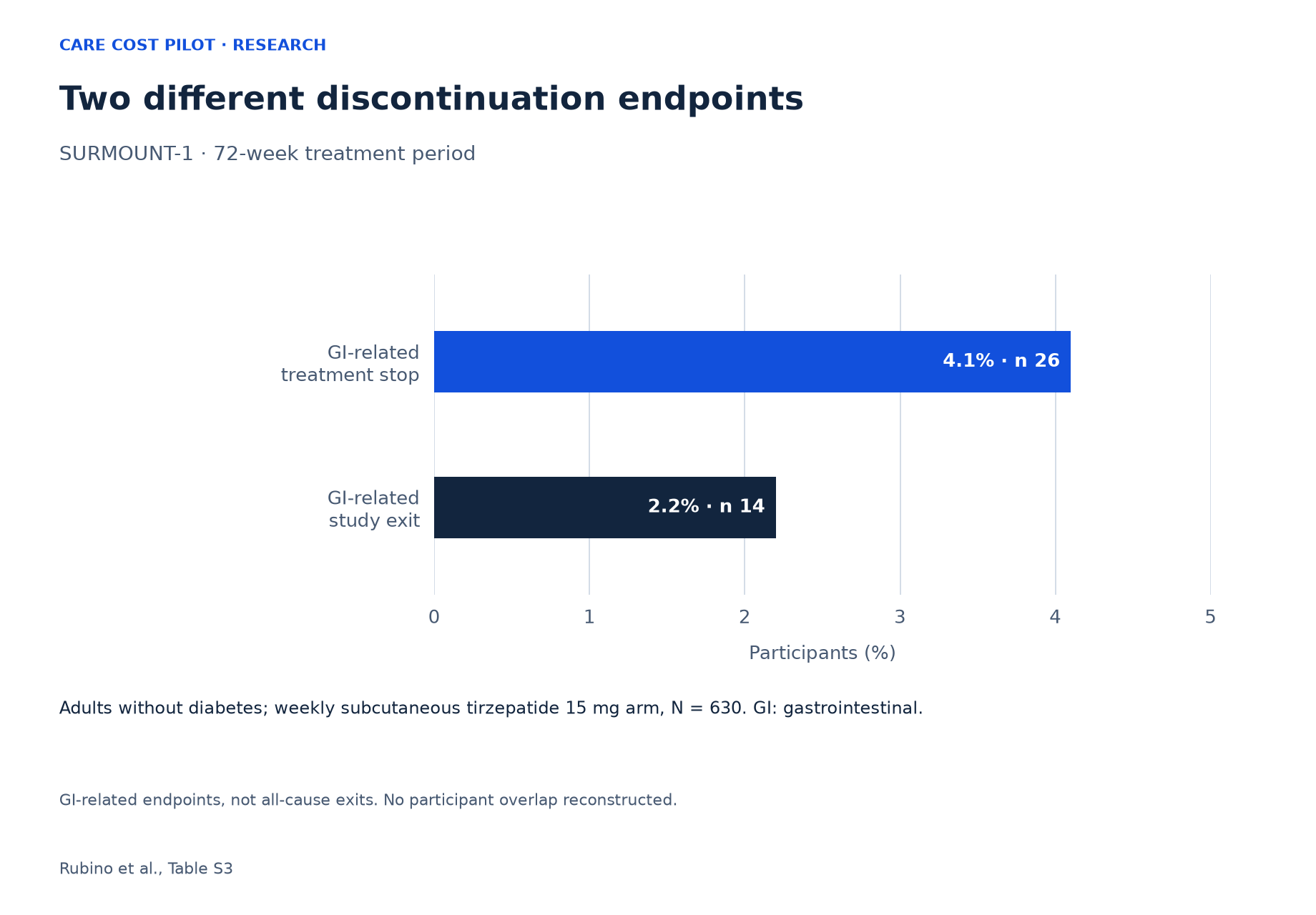
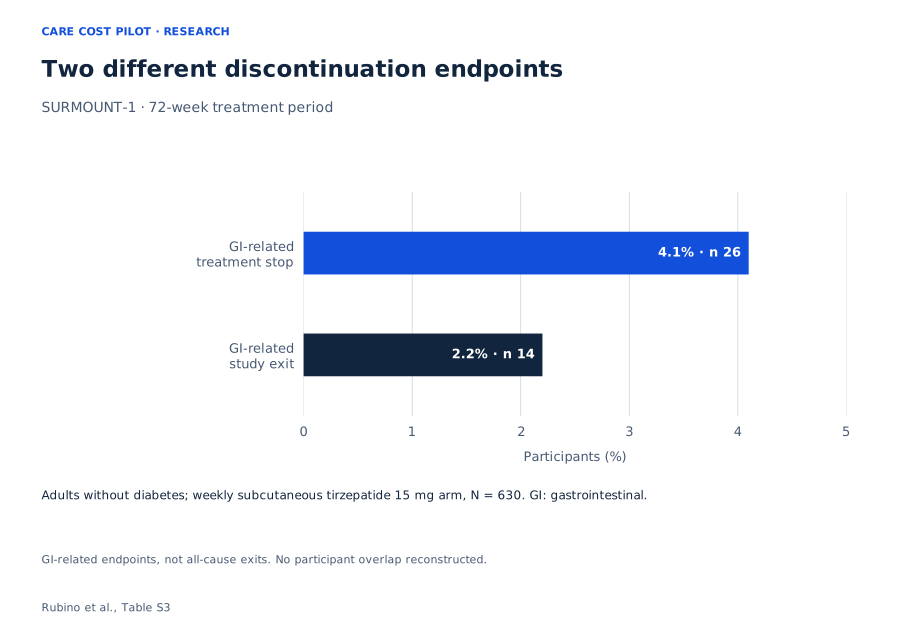
Two different discontinuation endpoints
Published rounded percentages; both rows refer to the same trial arm.
Different status definitions do not establish how the individual participants overlap.
Sources: Rubino 2025
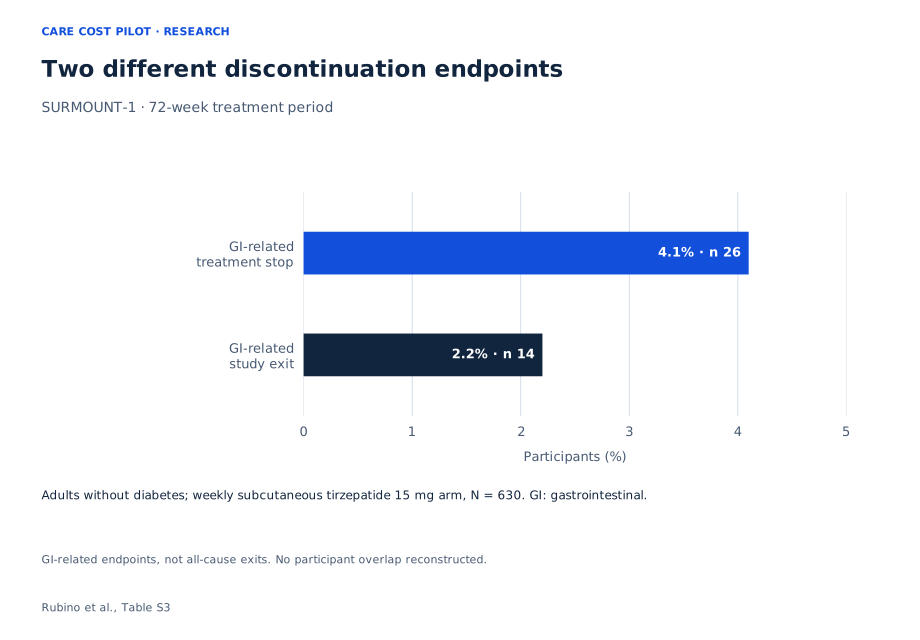
Adults without diabetes; weekly subcutaneous tirzepatide 15 mg arm, N = 630. GI: gastrointestinal.
| Endpoint | Participants | Percent |
|---|---|---|
| GI-related treatment stop | 26 / 630 | 4.1% |
| GI-related study exit | 14 / 630 | 2.2% |
Name the event before reading its percentage
Rubino et al. conducted a post hoc analysis, assessing trials separately. The chart selects one arm rather than pooling trials. Eli Lilly funded the analysis; six authors were employees and shareholders.
An endpoint is a rule for deciding which observations count. Before interpreting a stopping percentage, turn its heading into a sentence: someone stopped doing what, for which recorded reason, during which interval? Each phrase restricts the claim. Leaving an activity and leaving its observation process are different classifications. A reader who replaces both with “dropped out” removes information needed to understand the result. The figure preserves separate labels so that the question remains attached to each number.
The reasoning developed below is an original reading framework, with explicitly fictional examples to make the logic visible. It does not reconstruct the participants behind the chart. Start by writing an event dictionary before making comparisons: intervention exposure, contact with investigators, availability of a measurement, and inclusion in a particular analysis. Our companion discussion of semaglutide interruptions and follow-up approaches the same measurement problem from endpoint status. Keeping these definitions beside the figure is more useful than trying to compress every kind of departure into one success rate.
Sources: Rubino 2025
Two totals do not reveal who appears in both
Consider a fictional education audit, not a clinical dataset. Fifty learners begin a program. Nine leave the coursework, while four stop returning feedback. One possible arrangement places all four feedback departures among the nine coursework departures. Another places them among learners who continued coursework. Both arrangements produce the same two totals. In the first arrangement, five coursework departures remain in feedback; in the second, all nine do. Subtracting four from nine silently chooses the first arrangement.
The missing information is linkage: a record showing both classifications for each learner. A shared denominator makes the percentages comparable as fractions of one starting group, but does not supply that linkage. Nor does the smaller count establish a subset relationship. Such a relationship requires a documented definition or actual joint records. If the observation process itself makes one category necessarily part of another, state that rule and show where it comes from.
This distinction matters even when the arithmetic looks effortless. Arithmetic can process an assumption without testing it. Keep a separate column for assumptions and ask whether a conclusion holds under every arrangement consistent with the reported totals. If the answer changes when membership changes, the conclusion depends on information the margins do not contain.
| Record | What it establishes | What still needs evidence |
|---|---|---|
| Activity ended | A defined activity was discontinued | Whether observation also ended |
| Contact ended | A defined observation channel stopped | Whether the activity continued elsewhere |
| Measurement unavailable | The expected value was not obtained | Its unobserved value and reason for absence |
Sources: Rubino 2025
A reason code narrows the question
An outcome can be filtered by both action and reason. “Left the program” asks about an action. “Left because of a scheduling conflict” adds a cause classification. In a fictional language course, departures attributed to work schedules would not include departures attributed to relocation. A small count in the first category would therefore say little about the total number leaving. Removing the reason from a heading broadens the claim without broadening the evidence.
The reverse mistake is to treat everyone outside a selected category as having no difficulty. A person might have a different recorded reason, an unclassified reason, or no recorded departure at all. Those possibilities should not be merged by implication. When several reason categories appear, also check whether the reporting system permits multiple reasons or requires one principal reason. That rule determines whether adding rows has a coherent meaning.
For a practical analogy, a comparison of provider quotes needs a definition of what each quoted total includes. A narrowly defined item cannot stand in for the whole invoice. That analogy concerns classification, not clinical equivalence: a scientific event category and a commercial charge still require separate evidence.
Sources: Rubino 2025
An endpoint is a snapshot, not a journey
A status measured at the end of an interval does not encode every earlier transition. Imagine two fictional laboratory instruments that are inactive on the final inspection day. One was active until shortly before inspection. The other repeatedly switched between active and inactive periods. Their final status matches, but their operating histories differ. Without timestamps, the final status cannot reveal total operating time, the number of interruptions, or when a transition occurred.
To answer a question about duration, the useful evidence would include a defined starting point, dated changes, and rules for handling uncertain intervals. To answer a question about repeated events, the useful evidence would instead identify each event and its separation from the next. A table counting people with an event cannot automatically answer how many episodes occurred. Choose the record structure that fits the question before attempting a calculation.
The distinction also explains why a first payment and a renewal payment belong to a sequence rather than a single headline. This is an editorial analogy about time. A payment timestamp does not establish exposure, and an exposure timestamp does not establish a charge. Aligning calendars requires both records rather than borrowing a timeline from one to complete the other.
Sources: Rubino 2025
Initial assignment does not randomize later events
Random assignment concerns the mechanism that places people into initial groups. It does not generally assign every experience that occurs afterward. For an original nonclinical example, suppose learners are randomly offered two teaching formats, then an analyst compares those who later miss sessions with those who do not. Missed attendance may be associated with work demands, travel, motivation, or earlier learning difficulties. The later attendance groups were not created by the original allocation mechanism.
The appropriate question is what the comparison estimates after this selection. It may be a useful description of the records that meet a condition. It does not, by itself, estimate what would happen if an investigator caused that condition. An observed difference and the effect of an intervention that creates the grouping variable are different quantities. Naming that distinction is not an accusation of misconduct; it identifies the question supported by the design.
A helpful check is to sketch the order of events on paper: initial assignment, subsequent experience, classification, and measurement. Mark which step was assigned and which was observed. Then ask what information could influence both classification and the outcome. This exercise identifies assumptions worth discussing without inventing which influences operated in any particular participant.
Sources: Rubino 2025
Choose the observation window deliberately
Imagine a fictional machine study that records temperature only while a machine is operating. Another version records temperature throughout the full calendar interval, including shutdowns. The two versions answer different questions. Neither becomes interchangeable with the other because the operating machines were initially assigned fairly. The rule determining when measurements count is part of the measurement itself.
An analysis restricted to an active period can describe that period well while leaving the later period unanswered. To describe the whole calendar interval, an investigator needs later observations or a defensible way to account for their absence. Simply carrying an earlier value forward assumes a particular path afterward. Replacing a missing value with a group average makes a different assumption. The convenience of a method does not establish that its assumed path occurred.
This is why a reader should distinguish a blank cell from a measured zero. Zero is a value; missingness describes the information available about a value. Record the reason for missingness when possible, and keep the observation window visible when summarizing an analysis. Additional data might change the question that can be answered, but a more confident label alone cannot supply those data.
Sources: Rubino 2025
Specify the quantity a result is meant to estimate
A target quantity, sometimes called an estimand, is the question a study aims to answer expressed precisely enough to analyze. Specify whose outcomes matter, what is being measured, when it is measured, which comparison is intended, and how events that occur along the way will be handled. A statement about a final value and a statement about change over an interval need not identify the same quantity.
In an original teaching exercise, two analysts could use the same attendance records to estimate different things: course completion among everyone enrolled, or performance during periods of active attendance. Disagreement between their answers need not mean that one made an arithmetic error. They may have chosen different populations, measurement windows, or rules. A useful comparison begins by aligning those choices, rather than judging results solely by their numerical size.
The same discipline helps with monthly and prepaid payment comparisons. Decide whether the commercial question concerns money due now, money committed, or cost allocated to a period. This does not turn a financial calculation into a clinical analysis. It illustrates a shared reasoning task: a result is interpretable only when its target is explicit and the inputs actually describe that target.
Sources: Rubino 2025
Printed precision is not certainty
Rounding compresses information. In a fictional quality-control example, 12.44 percent and 12.36 percent both display as 12.4 percent when rounded to one decimal place. Equal printed values therefore do not prove equal underlying calculations. Conversely, different printed values do not establish that a difference is meaningful for a decision. Precision of display, uncertainty in an estimate, and the importance of a difference are separate issues.
Before calculating with a published percentage, check whether its denominator, counting rules, and rounding convention are known. A percentage might describe people, episodes, or an adjusted estimate; those are not interchangeable inputs. If a chart provides no interval around an estimate, do not interpret the absence of an interval as evidence that uncertainty is absent. Reconstructing one requires assumptions about how the data arose, not merely access to two visible numbers.
A reader can still make a useful descriptive statement while leaving uncertainty unresolved. Name what the estimate describes, retain the reported precision, and identify the information needed for a stronger comparison. Resist converting a descriptive margin into a forecast for the next individual. A forecast requires evidence about how well the original population and circumstances represent the situation being considered.
Sources: Rubino 2025
Keep the observation record beside the billing record
For care planning, our editorial interpretation is to maintain two separate records. The scientific record defines observations and their limits. The contractual record identifies charges, covered services, dates, and written conditions. A change in one record does not establish a corresponding change in the other. Treat the relationship as a question to investigate, rather than a missing value that a trial percentage can fill.
Use the questions before paying for online care to request the documents needed for the commercial side. Ask which written term addresses a changed care plan, what date makes a payment due, and which services a payment covers. These are requests for evidence, not assertions that any provider offers a pause, refund, or continued service. An unanswered question should remain visible rather than becoming a zero-cost assumption.
Provider-specific reading belongs in this documentary step. The Ro cost review and Mochi Health cost review can help organize questions about terms. Those links do not establish that a provider supplies the studied product or reproduces a trial outcome. Keep the actual written quote and relevant clinical advice separate from a publication’s example; each answers a different part of the planning problem.
| Question | Evidence to obtain | Unsupported shortcut |
|---|---|---|
| What was observed? | Defined outcomes and an observation window | Treating a payment as proof of exposure |
| What is payable? | A dated quote and applicable written terms | Treating a study exit as a refund rule |
| What happens after a change? | Specific clinical advice and contractual clarification | Assuming both records change together |
Sources: Rubino 2025
Use clinical information for a clinical decision
Zepbound is contraindicated with personal or family medullary thyroid carcinoma, MEN2, or known serious hypersensitivity to tirzepatide or its ingredients. Rodent thyroid tumors underpin the boxed warning; human relevance is unknown. Warnings include severe gastrointestinal reactions, dehydration-related kidney injury, gallbladder disease and pancreatitis. It is not recommended with severe gastroparesis. Discuss persistent or severe symptoms with a clinician, and obtain prompt assessment for severe persistent abdominal pain. Inform the procedural team before anesthesia. Individual changes to treatment require clinical advice, not a calculation from this chart.
An observation table and a prescribing decision serve different purposes. Reading a study carefully can improve the questions someone brings to a consultation, but a classification rule cannot assess their individual circumstances. The distinction is especially useful when a planning exercise creates pressure to force a complicated situation into one number. Leave the clinical question open for the appropriate conversation rather than choosing a course of action to make a spreadsheet balance.
A useful handoff is a short list of unresolved questions, with each directed to the person or document capable of answering it. Separate questions about personal care from questions about a recorded study outcome and questions about payment obligations. This keeps uncertainty specific. It also prevents an attractive calculation from appearing to settle something its inputs never measured. The final step is to check that every conclusion in a summary can be traced to the kind of evidence it requires.
Sources: Zepbound label; Rubino 2025
Questions about the evidence
Why not add two stopping percentages?
Addition requires categories that support the intended total. If people can appear in both rows, adding the margins may count some people twice. If reason categories omit other departures, even a nonoverlapping sum may describe only part of the outcome. Establish membership and coverage before deciding that a total is meaningful.
Sources: Rubino 2025
Does a common denominator solve the overlap problem?
It establishes a common reference group, but does not show how the numerators intersect. Joint records or a definition establishing a subset relationship are needed for that. A useful test is to construct different possible memberships with the same margins and see whether the desired conclusion changes.
Sources: Rubino 2025
Is an analysis of active periods automatically flawed?
No. Its value depends on the question it is intended to answer. The difficulty arises when a summary about an active period is presented as answering a different question about an entire calendar interval or everyone who started. Read the observation rule alongside the stated target.
Sources: Rubino 2025
Can a research endpoint predict a provider’s refund decision?
No endpoint definition supplies a contract. A payment question requires the applicable written terms and clarification of how they apply to the actual situation. A scientific analysis may help identify an uncertainty worth discussing; it cannot establish an unreported commercial obligation or erase an existing one.
Sources: Rubino 2025
What should remain unresolved in a careful summary?
Anything requiring information the record does not contain: individual overlap, unobserved histories, unsupported comparisons, or contractual consequences. Name the missing information and the decision it would affect. A useful summary can be precise about its boundaries without pretending that every open question has been answered.
Sources: Rubino 2025
Editorial assessment
Our editorial assessment is that a good stopping-table summary begins with definitions and ends with traceable claims. Preserve the event, denominator, timing, and observation rule; separate known margins from unknown membership. Use fictional examples to test the reasoning, then return to the actual evidence without importing the examples as results. For care planning, pair scientific questions with clinical advice and contractual questions with written terms. The benefit is a clearer decision process, not a numerical promise about an individual future.
Sources and access
- Gastrointestinal tolerability of once-weekly semaglutide 2.4 mg in adults with overweight or obesity, and the relationship between gastrointestinal adverse events and weight loss.
Full article and its Table 1 reviewed.
Checked 2026-10-26.
- Gastrointestinal tolerability and weight reduction associated with tirzepatide in adults with obesity or overweight with and without type 2 diabetes in the SURMOUNT-1 to -4 trials.
Full article and supplementary Tables S1 and S3 reviewed.
Checked 2026-10-26.
- DailyMed: WEGOVY semaglutide current prescribing information
Current official prescribing information checked October 26, 2026.
Checked 2026-10-26.
- DailyMed: ZEPBOUND tirzepatide current prescribing information
Current official prescribing information checked October 26, 2026.
Checked 2026-10-26.