Our Oat Meds GLP-1 care review examines a required care fee alongside the medication figure. This addition to the library was selected for its specific product or service format, rather than because a familiar wellness headline was attached to another brand name.
We read the official source October 4, 2026 and distinguish the seller’s statements from our analysis. This is a public-information review. We have not purchased, tested, or received the product or care, and a recent check date does not imply a new company launch.
What the GLP-1 care listing establishes
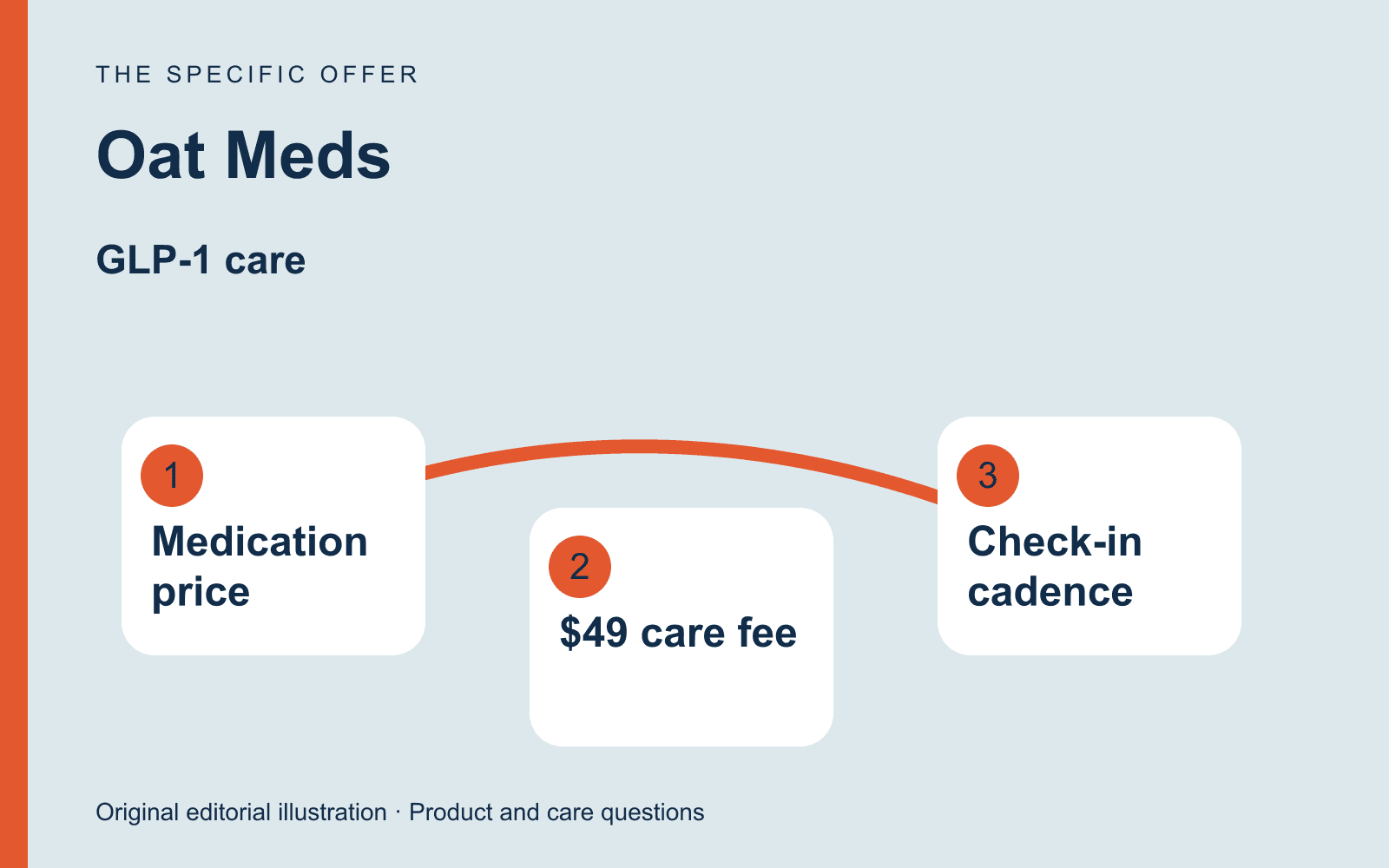
Oat Meds’ current page explicitly says the displayed drug price covers medication only if prescribed. It lists an additional required $49 Oat Care+ fee, paid during onboarding and check-ins, and says the program is not a subscription. That fee belongs in the complete-care calculation even when automatic recurring billing is absent.
The published pathway includes online intake, provider assessment, prescription if appropriate, and delivery or local pharmacy collection. The page discusses both compounded preparations and approved branded products. Those options should retain separate identities and coverage rules in a quote comparison.
The practical distinction
Ask how often check-ins are required and when each $49 payment becomes due. A non-subscription model can still involve repeated mandatory care payments. For insurance-supported medication, ask who handles authorization and how delays affect the intended start. The expected timeline is provider-advertised, not a shipping guarantee from this review.
The question to take to Oat Meds is specific: How many $49 Care+ payments are required over the next three months, and what medication charge is separate? Keep the answer with the current product or plan description. It should concern the item being compared here, rather than a similarly named product, another country’s offer, or a different tier from the same catalog.
The invoice, renewal, and commitment
For one onboarding charge, add $49 to the selected medication quote and any other required cost. For later care, count the actual required check-ins rather than adding $49 automatically every month. Without the chosen medication and check-in cadence, a universal three-month total would be incomplete. Keep pharmacy copay and care-program fee separate.
Save the selected quote and its conditions together. Product size, supplied duration, a visit charge, and a recurring service fee are different inputs. If an amount remains unquoted, leave it unresolved. A convenient payment format does not establish that Oat Meds is the lowest-cost complete option for every reader.
Match the claim to the evidence
The site’s product menu and weight-loss claims do not establish that a compounded preparation has the same approval or clinical evidence as a branded medicine. Prescription suitability depends on assessment. A care fee can be counted precisely while medicine eligibility, coverage, and formulation remain unresolved.
FDA explains that compounded GLP-1 products are not FDA-approved and describes risks with unapproved preparations. An approved branded medicine and a compounded prescription should keep their separate identities in a price comparison. Clinical suitability, the reason for compounding, and pharmacy quality cannot be decided by arithmetic alone.
Read two different comparisons alongside this review
Lavender Sky Health adds a comparison centered on total payment versus monthly-equivalent pricing across pharmacy plans. Its named offer is pharmacy-specific treatment plans. Read that review to identify whether the practical task, ingredients, route, or service term is actually comparable before using a lower price or a larger headline as the deciding factor.
Amble takes another approach through online weight-care access, with multiple starting figures and a managed-services role as the main review question. Keep those differences visible. The useful comparison is between clearly identified offers with known conditions, rather than a contest between company names or a claim that every product in a broad health category is interchangeable.
Our view and the next useful question
Oat Meds is a useful niche cost review because its fee structure differs from a straightforward medicine-inclusive subscription. The strongest question is when the mandatory care fee recurs. Compare it with a complete quote from another provider using the same care period and exact medication category.
Before deciding, resolve the exact identity, the complete commitment, and the question this review leaves open: How many $49 Care+ payments are required over the next three months, and what medication charge is separate? Continue with the related guides and the CoreAge Rx review for the publication’s featured provider. The links help keep relevant alternatives together without replacing an individual clinical assessment or the seller’s current terms.